I’m starting a new series of posts, elaborating and iterating on The Auto-Immune Manifesto, a plague document that lays out my fundamental statements about illness and culture, composed in 2021. It is a fundamentally enigmatic, polemical 22 point list. It is most definitely not a protocol. I’m now going to say more.
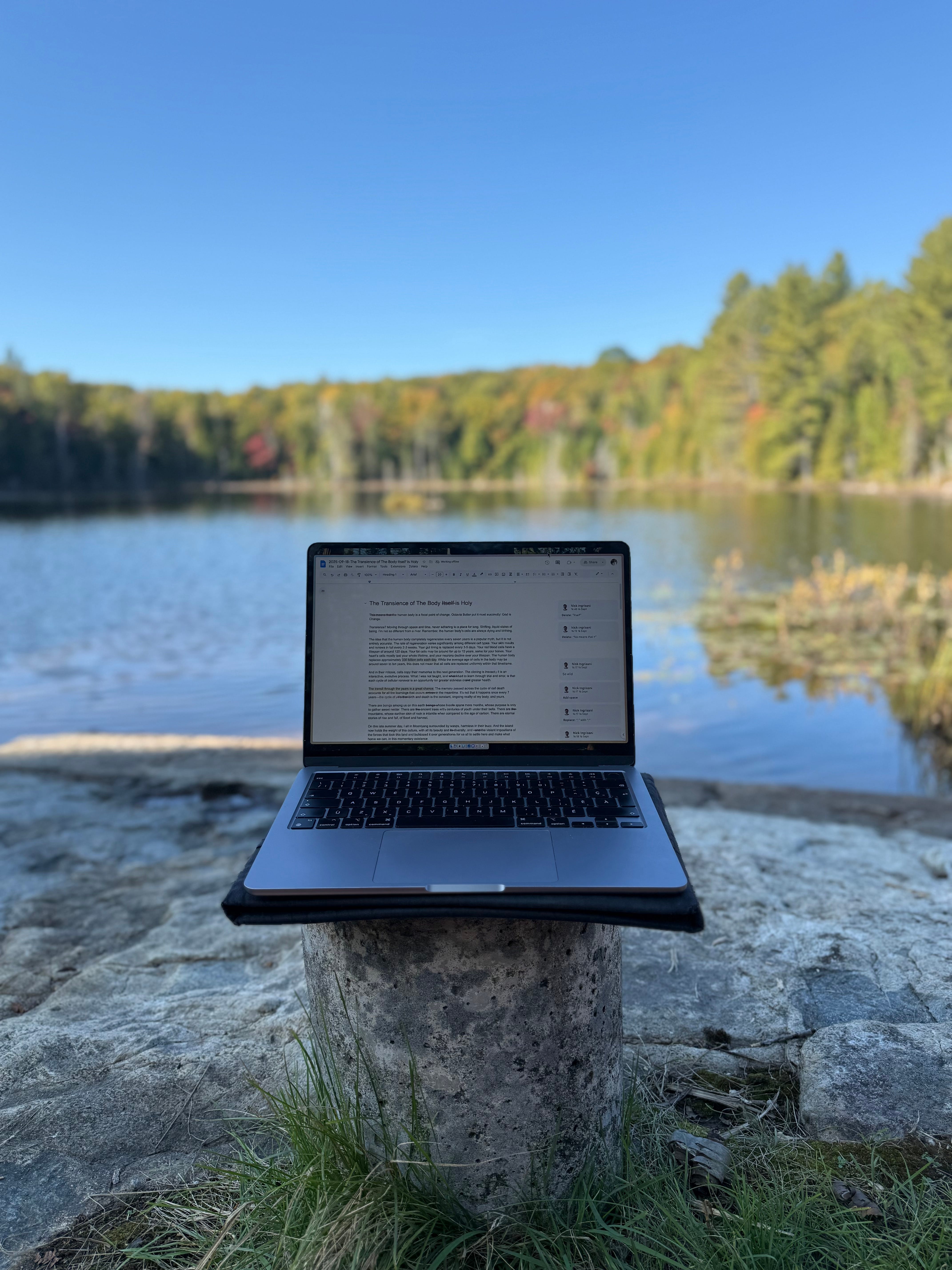
Transience? The human body is a focal point of change. Moving through space and time, never adhering to a place for long. Shifting, liquid states of being. Not so different from a river. Remember, the human body’s cells are always dying and birthing.
The idea that the human body completely regenerates every seven years is a popular myth, but it is not entirely accurate. The rate of regeneration varies significantly among different cell types. Your skin moults and renews in full every 2-3 weeks. Your gut lining is replaced every 3-5 days. Your red blood cells have a lifespan of around 120 days. Your fat cells may be around for up to 10 years, same for your bones. Your heart’s cells mostly last your whole lifetime, and your neurons decline over your lifespan. The human body replaces approximately 330 billion cells each day. While the average age of cells in the body may be around seven to ten years, this does not mean that all cells are replaced uniformly within that timeframe.
And in their mitosis, cells copy their memories to the next generation. The cloning is inexact; it is an interactive, evolutive process. What I was not taught, what I had to learn through trial and error, is that each cycle of cellular renewal is an opportunity for greater sickness or greater health.
The memory passed across the cycle of cell death accounts for all the learning that occurs in the meantime. Each passing lunation, how is my relationship to to my present and my past evolving? What have I integrated about my trauma and my success? How have my prayers changed? What is the same, and what is different?
It’s not that it happens once every 7 years—the cycle of birth and death is the constant, ongoing reality of my body, and yours.
I was surprised to learn taht the words “holy” and "health" share a common Proto-Indo-European (PIE) root, *kailo-. Its likely meaning is "that must be preserved whole or intact, that cannot be transgressed or violated." This root led to Old English hal (from which "health" is derived) and Old High German heil meaning "health, happiness, good luck."
After the Anglo-Saxon conversion to Roman Christianity in the late 6th century, "holy" was used in Old English for the Latin sanctus. I wrote last time about the word sanctuary, which we got from sanctus: the sacred, inner space. In Middle English, holy was also used for pagan gods, the Hebrew temple or tabernacle, and in the Quran and Muslim doctrine.
Holy refers to what is unbroken, which is whole at the source of life.
Transience is an unassailable fact. For all the cultural attempts to behave as if things are eternal and static, there is nothing but change in this realm. The monadic, advaitic God is All that Is, and is therefore also Elohim Chaim, the Living God, who is the force behind and within decay itself. God is change.
On this late summer day, I sit in Mooniyang surrounded by wasps, harmless in their buzz. The island holds the weight of transient culture, with all its beauty and diversity, with the millenia of growth and change and decay, the impositions of the forces that took this land and bulldozed it over generations for us millions of humans from across the globe to eventually settle here and make what home we can, in this momentary existence.
There are beings among us on this earth whose lives span mere months, whose purpose is only to gather sweet nectar. There are ancient trees with centuries of youth under their belts. There are mountains, whose earthen skin of rock is infantile when compared to the age of carbon. There are eternal stories of rise and fall, of flood and harvest. Holiness is a profoundly religious word. It is perfection, beyond human intervention. Holy is the realm of the gods. But I’m suggesting that natural events—birth, death, renewal, decay, the movement of the tectonic plates, the rise and fall of mountains—are holy precisely in that they are supremely inevitable and true. Truth is a phenomenon before its interpretation by the judging mind. Holiness is perfect and needs no validation by a human institution.
My bones are in the shape of the earth. The minerals in my water result from the sewage here. The ancestral dreams of hearth and kin were realized and lost, and many songs have been forgotten. This little life of mine longs for a context unfractured, yet accepts that I was born of fragments. The transience of my body is holy, because it lives and breathes with the tides. The rhythm of storms come and gone, the aquifers filled and emptied.
My transit through the years is a great chance. It is an opportunity to be changed, to witness the transitions in the cycle of life. The seasons of civilization are as consistent as my body’s, with its hiccups and sputters. Nearly as predictable as the seasons, even in this disrupted ecology, with climate collapsing everywhere I look.
Not one thing in this world is permanent, and I am no exception. It’s intelligence of a scale beyond reckoning, one that takes no quarter nor plea. That I may be born and bleed for years is only the gift of this life for me. Nothing more or less is asked, that I may learn what is to be learned. It’s a dance, this ephemeral art of living, a great prayer sung to the winds. All I ask is to decompose gracefully, to return to the soil in peace. Maybe when we’re all composting, the next culture will be flourishing at last.
When I wake up, as the transient dreams are departing, If I listen closely they are full of lessons. I may be different each new waking moment, forever changed by my here and now. What if this isn’t to be mourned or bemoaned? What if instead, it’s an opportunity for rapture? If you listen closely, the transience of the body is holy.