

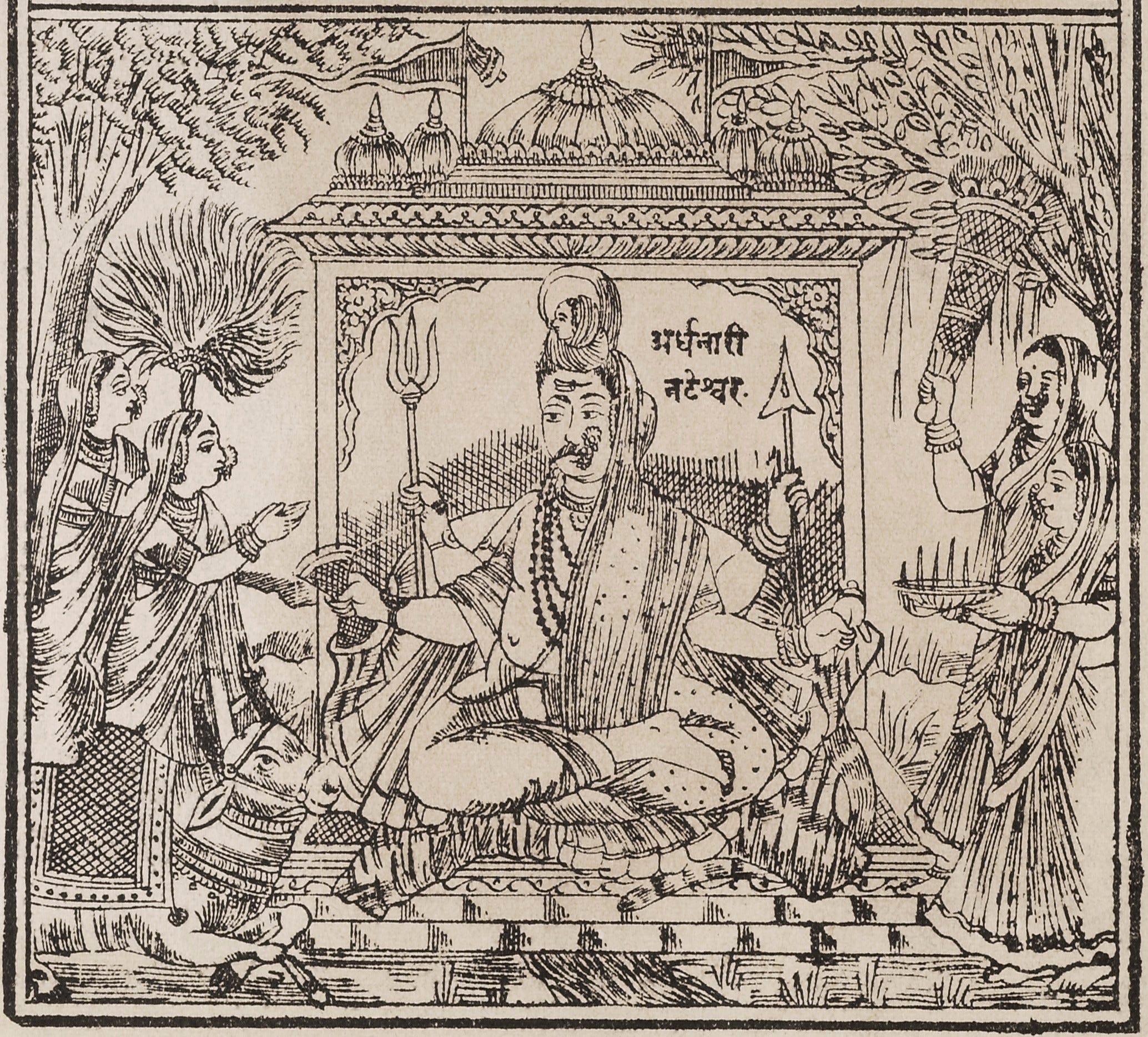
Before the lungs fill, before the cry, before the skin meets open atmosphere, the body has already been written. Every year, the spleen remembers. I lost mine in August of 2001, and still the pattern holds. My bruises arrive on schedule. The count drops according to a geometry I can describe but not exit. Whatever the spleen encoded, the rest of the body learned it by heart.
I know this the way you know weather in a joint: not as information but as pressure arriving before the language to describe it. Twenty-five years of immune thrombocytopenia[1] have taught me to read the season in my platelet count. The bruises come first. Then petechiae, the fine red scatter across the shins that means the count is dropping. The haematologist will call it relapse. The general practicioner will tell me to see the haematopathologist. The Ayurvedic framework names the condition Rakta Pitta, the blood’s own fire turned against its vessel. Pitta gets aggravated and the blood cannot stay in the channels.
I have spent twenty-five years as a subject of the biomedical literature on why this happens, and the literature keeps arriving at a threshold it cannot cross. The data points backward through time, through bodies, through landscapes, and the frameworks keep insisting on linearity. I want to tell you what the data actually says, because it says something the researchers cannot quite bring themselves to conclude.
Autoimmunity is ancestral. Autoimmunity is ecological. It is the immune system operating exactly as it was built to operate, but built under conditions that no longer exist.
If you were born in April in the Northern Hemisphere, your risk of developing an autoimmune disease is measurably higher than if you were born in October. This holds across more than a hundred thousand patients, across multiple diseases. The wave rises and falls with the calendar like a tide.[2] The reason is light. Vitamin D, made in the skin when ultraviolet light hits it, is the molecule that teaches certain immune cells to be tolerant. It changes their posture and calms them. Without it, those cells never learn to recognize the body’s own tissues as safe.[3] If you were gestating during the dark months, if your mother’s skin saw almost no ultraviolet light during the trimester when your immune system was learning what to tolerate, the teaching simply didn’t happen. The architecture was never built. The darkness is not a risk factor. The darkness is the shape of the immune system itself. This may be why it is now recommended pregnant women take Vitamin D supplements.
I was conceived in May. My second trimester fell across the autumn. My third, the one that matters most for this, landed in deep winter. February in the Northern Hemisphere.
At the same time, another system was being set. A gene builds the receptor for cortisol, the stress hormone, and this receptor anchors the feedback loop that tells the stress system to stand down: cortisol rises, the receptor catches the signal, the system dials back.[4] In babies born to highly stressed or traumatized mothers, a small chemical tag drops onto the DNA at this gene before birth and the gene goes dark. The receptor never gets built. By three months, these infants flood with stress hormones in response to mild stimuli, regardless of how the mother is doing after birth. The alarm was set before the child met the world that was supposed to cause it. This has been documented in the children of depressed mothers, survivors of the Rwandan genocide, and families of Holocaust survivors.[5]
My mother was a traumatized woman, an abuse survivor. The cortisol in her blood during those nine months was not a metaphor for stress. I would not even need to know the content of her story for the biology to carry over. It was the physical substance of it, crossing the placental barrier and landing in me as chemistry.
If both these systems fail at once, if the immune cells never learn tolerance because there is no vitamin D and the stress-response feedback loop has no anchor because the cortisol receptor was silenced, then both brakes are gone.[6] What gets diagnosed years or decades later as autoimmune disease is the consequence of an architecture that was set, in darkness and in cortisol, before birth.
The data goes further back than one generation. In Sweden, researchers tracked over four hundred and fifty thousand children and found that when men experienced bereavement in childhood, the children of those men, conceived years or decades later, developed autoimmune disease at significantly higher rates. No social or economic factor explained it. The transmission was biological and direct.[7]
In a separate study, mice trained to fear a specific smell produced pups and grandpups who startled at that same smell despite never having encountered it. The researchers removed every possible route of social learning by extracting the sperm, fertilizing in a dish, and having the pups raised by unexposed mothers. The fear persisted. It was written into the sperm itself.[8]
And in Holocaust survivors, a gene that regulates cortisol sensitivity carries an epigenetic tag elevated compared to controls. In their children, born decades later on a different continent, the same tag is lower. The adjustment moves in the opposite direction, as if the offspring’s biology is preparing for an anticipated environment of extreme stress it has never directly experienced.[9]
This is what I mean by ancestral. My paternal grandparents were the sole survivors of their respective families through Auschwitz.
The grandfather’s grief is in the grandchild’s platelet count. Not as metaphor. As chemistry. As a molecular tag on a stretch of DNA that says: the cortisol flooded in. Not when, not where, not to whom. Just that it happened. The mark does not encode time as a sequence. It encodes time as structure.
In 1998, a five-day ice storm knocked out power across southern Quebec. Researchers tracked pregnant women through the disaster and separated what objectively happened to them (days without power, temperature drop, caloric disruption) from how they felt about it (fear, emotional distress, cognitive appraisal). Thirteen years later, the children’s immune cells showed massive epigenetic rewriting across nearly a thousand genes, and these changes tracked precisely with objective hardship. How frightened the mother felt, how she narrated it to herself, was completely uncorrelated.[10] The fetal immune system did not record the story. It recorded the cold. The thermodynamic fact. The number of days without heat.
A 201-country study confirmed that average annual temperature predicts the prevalence of five major autoimmune diseases with overwhelming statistical strength.[11] Cold environments concentrate autoimmune conditions. But the same nutritional deprivation in the Gambia produced no equivalent immune shift, because the ecology is different, the microbiome is different, the endemic organisms are different, the soil is different. The environment does not surround the body as context. The environment is the body. The gut lining is an internalization of the soil. The respiratory membrane is an internalization of the atmosphere. That is what I mean by ecological.
I was born to a blood bath. My mother hemorrhaged during her 30 hour delivery and had to be transfused, someone else’s blood entering her body as mine was leaving it. Then her milk was insufficient and I was fed by surrogates. Other women’s milk, other women’s microbiomes, seeding my gut with ecosystems that were never meant to be mine. At five, I was diagnosed. The treatment: spleen removal and prophylactic antibiotics, which burned the gut flora to the ground. Intravenous immunoglobulin pooled from the plasma of thousands of donors, infused directly into my bloodstream to modulate the immune system that could not recognize its own platelets. The treatment for the failure of self-recognition is the introduction of thousands more selves.
Auschwitz in the germline. Cortisol in the placenta. Winter in the genome’s folds. A stranger’s blood in the veins. Other women’s milk in the gut. Thousands of strangers’ immunity in the infusion bag. The boundary between self and other was crossed and re-crossed before I had language. The self was never one thing.
It is not the cold that triggers the relapse. It is the transition. I left Montréal on December 31st and was sick in Thailand by January 3rd. I left Thailand in February and relapsed when I landed in Kerala. Last April, I went south to New York and got a severe flu. The bruising showed up in Montréal three weeks later with the thaw.
The pattern lives in the crossing from one thermal regime to another, the sudden change in temperature that cracks the fire pot. The immune system, calibrated to the cold, meets the heat and cannot recalibrate fast enough. ITP peaks in spring alongside viral triggers, at exactly the moment when vitamin D stores are at their lowest after the winter trough.[12] The system, unable to complete its tolerance signaling, meets a routine pathogen and the absence of the background condition turns the encounter into a cascade. The fire at what used to be the spleen still works through the blood, but the fire is calibrated to a thermodynamic reality that no longer matches the present season. The platelets are consumed not because they are foreign but because the apparatus that would have recognized them as self was never fully assembled.
The perceived contaminant is the self, but which self? The one that arrived through the placenta, already formatted by winter and cortisol and the long shadow of Auschwitz? The one reconstituted by a stranger’s blood on the first day? The one colonized by another woman’s milk? The one periodically flooded with the pooled immunity of thousands of donors? The one whose gut microbiome was decimated by antibiotics and rebuilt from whatever remained?
The immune system is not failing to recognize the self. It is performing an exact calculation on a self that was always plural.
I should say plainly that every time I use English to describe Ayurvedic concepts, I am already mistranslating. The frameworks do not map onto each other. When I say ojas and gloss it as “the luminous substrate of immunity,” I have already lost something essential. The word carries a density of meaning that belongs to a knowledge system structured by different axioms, different observations, different millenia of clinical reasoning. When I draw parallels between epigenetic data and desha prakriti, I know I am doing something that risks flattening both. I do it anyway, because I know no other way to begin to make sense of my own experience than to translate as I learn. The translation is imperfect. The experience is not.
The Ayurvedic tradition calls the continuity of body and land Desha Prakriti, the season threading through the embryo’s blood vessels, modifying the solvent before the solute crystallizes. Winter tightens the tissue. Summer loosens it. The flesh is weather held under a dermis.[13] It names my condition Rakta Pitta and classifies it clearly: manageable, but incurable.[14] There is no promise of restoration to some imagined original wholeness. There is care, precise and ongoing.
And it says something the biomedical literature cannot say, because the biomedical literature does not have the vocabulary for it. Caraka lists, among the primary factors that deplete ojas and open the body to disease: chinta, bhaya, shoka. Worry. Fear. Grief.[15] Not stress, which is mechanical. Not trauma, which is an event. These are placed not among the psychological complications of illness, not as downstream consequences, but as root causes, on equal footing with excess fasting, with adverse season, with exposure to wind and sun. Before the inflammation, before the cascade, before the fire at the spleen burns through the blood: grief. And its antidote, also from Caraka: dhee dhairya atmadi vijnanam. "Intellect, courage, and self-realization are the supreme medicines for disorders of the mind." What the gut cannot break down, the mind cannot clear. What the mind finds the courage to face, the channels can begin to process.
I carry an incurable condition. It is manageable. The spring bruises come and the spring bruises go. The count drops and the count recovers as the fractal geometry repeats. This is not a story of healing, it is the story of tending to a garden.
What strikes me is how long it took Western science to arrive at what Caraka stated without fanfare. The passage on ojas depletion lists the causes plainly: excessive exercise, fasting, worry, fear, grief, dry and scanty meals, exposure to wind and sun, insomnia, adverse season.[15-1] Read that list after reading the epigenetic literature and something shifts. Adverse season is not a metaphor for seasonal affective disorder. It is the angle of the ecliptic during the second trimester. Grief is not a psychological complication of being ill. It is a primary cause of the depletion of the body’s deepest reserve. Fear is not an emotion to be managed. It is an etiological factor, written into the same list as fasting and wind, granted the same clinical weight.
The biomedical literature needed the ice storm, the Swedish cohort, the mice startling at their grandfather’s fear, the Holocaust methylation studies, and a 201-country regression analysis to begin to see what Caraka organized into a single verse. I do not say this to diminish the science. The science is extraordinary, and its precision matters. I say it because the convergence itself is the point. Two knowledge systems separated by millennia, geography, language, and epistemology arrive at the same claim: the body is not separate from the conditions that formed it. The environment is not backdrop. It is etiology. And grief, fear, and worry are not secondary to the physical causes of disease. They are physical causes of disease.
Caraka also offers the antidote, in a formulation so compressed it could be missed: dhee dhairya atmadi vijnanam. Wisdom, courage, and self-knowledge are themselves therapeutic.[15-2] Not as psychology. Not as positive thinking. As clinical intervention, placed in the therapeutic literature alongside diet, herbs, and seasonal regimen. The treatment for an incurable condition shaped by ancestral grief, adverse season, and a self that was never singular is not a drug that restores the architecture. It is the cultivation, ongoing and precise, of the capacity to understand what happened, to face it without flinching, and to know the self clearly enough to navigate what cannot be repaired.
I do not know how to end this essay because the condition does not end. The geometry repeats. The springtime bruises will come again. What I know is that the body I carry was written before I was born, by the light and the cold and the grief of people I never met, and that the work is not to undo the writing but to learn to read it.
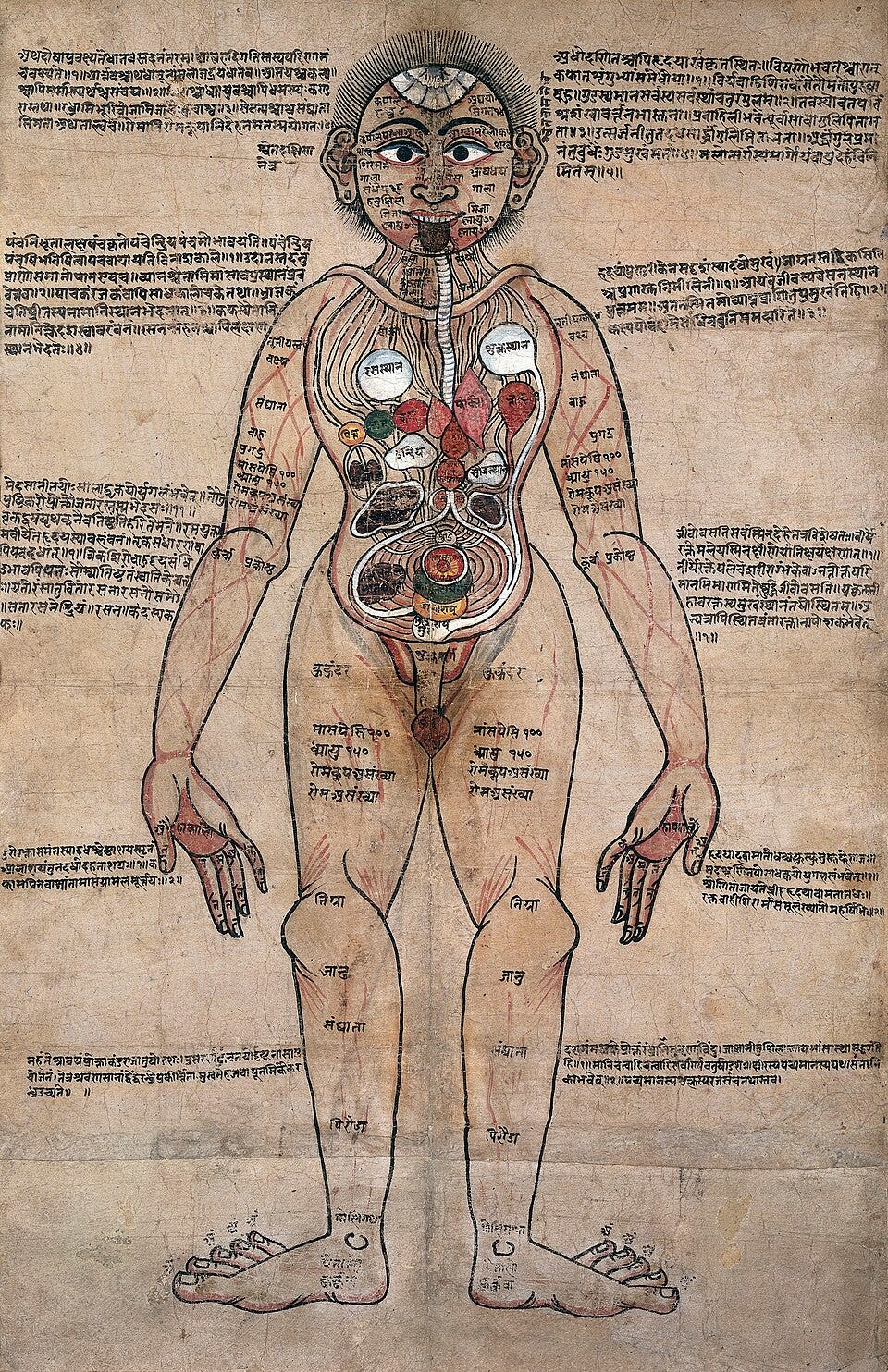
Immune thrombocytopenia (ITP) is an autoimmune condition in which the immune system destroys the body’s own platelets, the cell fragments essential for blood clotting. It is classified as a rare disease. In Ayurvedic clinical terms, it is understood as a form of Rakta Pitta, but Rakta Pitta is a broader category than ITP.↩︎
Goldacre et al., 2013. 115,172 UK patients across multiple immune-mediated diseases. April peak (OR = 1.045, P < 0.0001), October trough (OR = 0.945, P < 0.0001). Second trimester UVB correlation: Spearman’s rho = −0.49, P = 0.00005.↩︎
Hsu et al., 2018. Vitamin D Receptor (VDR), activated by calcitriol, forces dendritic cells toward a tolerogenic phenotype: upregulating inhibitory molecules, suppressing CD80/CD86, dampening IL-12 and IL-23. VDR binds at CTCF motifs dictating borders of topologically associated domains (TADs), restructuring chromatin architecture. Six MS risk genes co-localize with VDR binding regions in dendritic cells.↩︎
Oberlander et al., 2008. Glucocorticoid receptor gene NR3C1, exon 1F. Methylation at the NGFI-A binding site silences receptor expression, disrupting HPA axis negative feedback and Th1/Th2 cytokine balance. Altered cortisol reactivity at three months independent of postnatal maternal mood.↩︎
NR3C1 methylation replicated across cohorts: Rwandan genocide survivors (Perroud et al., 2014), Holocaust survivor families (Yehuda et al., 2016), domestic violence-exposed mothers (Radtke et al., 2011).↩︎
Morante-Palacios et al., 2021. Coordinated glucocorticoid receptor and MAFB action in tolerogenic epigenome remodeling. Dual absence of VDR-mediated calcitriol signaling and GR-mediated cortisol feedback simultaneously strips both primary regulatory mechanisms. Cao-Lei et al., 2014 (Project Ice Storm) demonstrated that objective hardship, not subjective distress, predicted genome-wide DNA methylation changes at 1,675 CpG sites across 957 genes in offspring T cells at age 13, enriched for NF-κB signaling and Th1/Th2 cytokine regulation.↩︎
Song et al., 2021. 453,516 Swedish children born 2001–2012. Paternal childhood bereavement associated with offspring autoimmune disease: HR = 1.31 (95% CI: 1.06, 1.62). No mediation by SES or mood disorders.↩︎
Dias and Ressler, 2014, Nature Neuroscience 17:89–96. F0 olfactory fear conditioning to acetophenone. F1 and F2 behavioral sensitivity, enlarged M71-specific glomeruli, CpG hypomethylation at Olfr151 in F0 and F1 sperm. IVF and cross-fostering confirmed biological inheritance.↩︎
Yehuda et al., 2016. FKBP5 gene methylation. Holocaust-exposed parents: higher methylation. Offspring: lower. Orthogonal transmission suggesting compensatory rather than mimetic epigenetic inheritance.↩︎
Cao-Lei et al., 2014 (Project Ice Storm). Objective hardship predicted DNA methylation changes at 1,675 CpG sites across 957 genes in offspring T cells at age 13. Genes enriched for NF-κB signaling and Th1/Th2 cytokine regulation. Subjective distress uncorrelated. Dancause et al., 2015.↩︎
Rademacher et al., 2024. 201-country regression. Robust linear correlation (p < 0.0001) between average annual temperature and age-standardized prevalence of alopecia areata, type 1 diabetes, IBD, psoriasis, and rheumatoid arthritis.↩︎
Moulis et al., 2015. Seasonal peaks in adult ITP: 35.8% spring, May = 18.2%. Corticosteroid resistance in spring-onset: 52.1% of resistant cases (p = 0.001). 62.7% of chronic patients diagnosed in spring.↩︎
Charaka Samhita, Sharira Sthana. Embryological formation as negotiation between inherited seed and atmospheric conditions. Seasonal modulation through Rtu: Ashtanga Hridayam, Sutra Sthana. Desha Prakriti: the constitutional type shaped by the geographic and climatic conditions of conception and gestation.↩︎
Charaka Samhita, Nidanasthana 2.4. Jwara (fever) has as its cause vitiation of doshas (V, P, K, VP, VK, PK, VPK). Fever causes Rakta Pitta. Pitta gets aggravated and blood cannot stay in the channels. Curable if of Kapha type, palliable if of Vata type, incurable if both.↩︎
Charaka Samhita, Sutra Sthana 17.73–77 (Kiyanta Shiraseeya Adhyaya). Ojas is described as the very first substance created in the body, situated in the heart, clear and slightly red-yellowish; its destruction leads to death (17.74). Symptoms of its decrease: timidity, debility, constant worry, discomfort of the senses, loss of lustre, dryness, emaciation (17.73). General causative factors for depletion of ojas: excessive exercise, fasting, worry (chinta), fear (bhaya), grief (shoka), dry and scanty meals, exposure to wind and sun, insomnia, excessive excretion, adverse season, and major mental illness (bhuta-upaghata) (17.76–77). Cf. Charaka Samhita, Sutra Sthana 25.40: dhee dhairya atmadi vijnanam.↩︎↩︎↩︎
Such a deeply emotive and informative piece. I'm continually fascinated and humbled by your syntheses of body, environment, ancestry, ecology, and life.
Fascinating to read about the intersection of these studies and knowledge systems and how we can learn to better understand ourselves. Thank you for sharing this Laure