

The first bruise I remember noticing was not a bruise. It was an accident, a plastic helicopter toy striking my right eye and causing its front chamber to fill with blood. I was five, it was July 2001.
At the same time, my mother noticed the petechiae: tiny hemorrhages under the skin, red-violet points that did not blanch when pressed. When we went to the hospital for my eyes, we entered a parallel track in haematology, and the blood test came back at functionally 0 platelets per microliter. Normal range is 150,000 to 450,000.
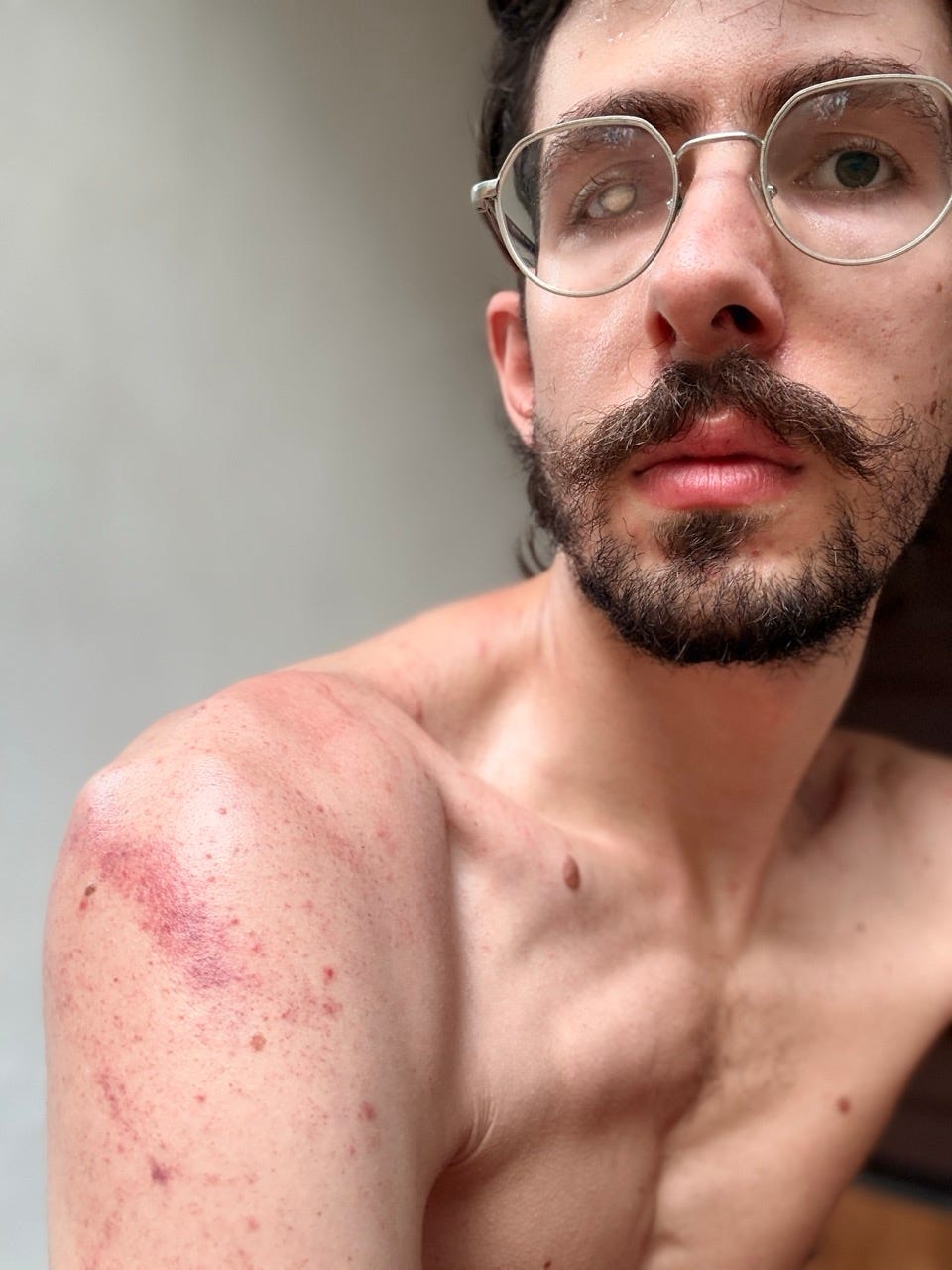
The hematologist told my mother that my immune system was destroying platelets faster than the bone marrow could produce them, and that I likely suffered from idiopathic thrombocytopenic purpura (a now defunct name). We learned some new words that day. One word in particular, idiopathic, which means: we do not know why your child is bleeding, with the subtext, but if we don’t act now, it will get worse.
I have had immune thrombocytopenia for twenty-five years. In that time I have been told many things about what my body is doing. The language offered has been almost entirely military. The immune system attacks the platelets. The body has turned against itself. Autoantibodies target glycoproteins on the platelet surface, opsonize them, mark them for destruction by macrophages in the spleen. The metaphor is friendly fire and civil war: a defense system that cannot distinguish friend from enemy, self from non-self.
I have never found this language accurate to the experience. The experience is not of being attacked. The felt sense is of dissolving; blood does not coagulate as it should, a bruise appears without impact, a cut bleeds longer than expected, gums are sticky and taste a little bit like iron. The sensation is less martial than hydraulic: a body whose fluid boundaries have become unreliable, whose containment leaks.
The language matters because it determines what questions get asked. If the immune system is attacking, the question becomes: how do we stop the attack? And the treatments follow that logic precisely. Corticosteroids suppress immune activity broadly, a pharmacological ceasefire. Rituximab depletes B cells that produce autoantibodies, eliminating the factory. Splenectomy removes the organ where tagged platelets are destroyed, dismantling the killing floor. Thrombopoietin receptor agonists stimulate the bone marrow to produce more platelets, flooding the field with reinforcements. Each intervention has a logic, and each logic is downstream of the metaphor. None of them asks why the immune system began treating platelets as wrong in the first place.[1]
What the immune system actually does in a healthy body is more complex than the military metaphor permits. Half of circulating antibodies are not specific to anything in particular. They attach broadly, loosely, to many surfaces, recognizing not a single organism but the general texture of biological matter.[2] Antibodies clear the debris that accumulates when cells die. They are composters.
A quarter of the antibodies produced in the gut target the bacteria that live there permanently, not foreign organisms, and maintain a molecular boundary that permits coexistence rather than demanding elimination.[3] Regulatory T cells exist specifically to suppress immune responses, continuously maintaining the conditions under which the immune system does not react to self.[4] Tolerance is not a default state. It is ongoing labor.
The self/non-self model that structures biomedical immunology was first articulated by Macfarlane Burnet and his team in the 1940s. It frames the immune system as a border patrol that identifies foreign material and eliminates it. In this model, autoimmunity is border patrol turning on its own citizens.
But the immune system manages the maternal-fetal interface, tolerating genetically foreign tissue for nine months. It clears billions of apoptotic self-cells daily without triggering inflammation. It maintains a working symbiosis with trillions of commensal organisms. The relational work the immune system performs, the composting, the boundary-tending, the tolerance of the foreign and the clearing of the self-that-has-died, dwarfs its defensive function.
The Brazilian immunologist Claudio Viera Da Silva recently published a cutting analysis of immunology’s colonial metaphors, and he identifies this framing as a product of the coloniality of power: the field’s language of defense, attack, soldiers, and enemies imports assumptions from a specific political cosmology and projects them onto biological processes that precede that cosmology by several hundred million years.[5] The military metaphor makes certain interventions obvious (suppress, eliminate, remove) and renders others invisible (restore relationship, re-establish boundary, support the regulatory function that maintains tolerance). The vocabulary constrains the pharmacology.
My body does not experience autoimmunity as warfare. It experiences it as a kind of porousness, a failing of the containment that healthy tissue provides without anyone noticing. Something not holding.
In August 2001, my spleen was removed. The logic was straightforward: the spleen is where antibody-coated platelets are filtered from circulation and destroyed by macrophages. Remove the primary site of destruction, and platelet counts should rise. Mine did, at first. The surgery was considered successful. Temporarily, sure, it was.
What was accepted as “collateral damage” at the time is that splenectomy permanently altered my immune terrain. The spleen is the largest secondary lymphoid organ in the body. It is where marginal zone B cells reside, where blood-borne antigens are first encountered, where the immune system generates its responses to encapsulated bacteria.[6] Its removal means lifetime vulnerability to overwhelming post-splenectomy infection, a risk managed through vaccination and preventative antibiotics but never eliminated. The surgery solved one problem by creating another, trading hemorrhagic risk for infectious risk. In biomedical terms, an acceptable exchange. In the terms of the body living it, a permanent reconfiguration of the conditions of being alive.
I began studying traditional Asian medicines when I was in my twenties. When I did, the splenectomy and the bleeding all acquired a different legibility.
In Ayurvedic pathophysiology, what I carry is not called immune thrombocytopenia. It is called Raktapitta: a condition in which Pitta, the principle of heat and transformation, enters and vitiates Rakta dhatu, the blood. The blood becomes too hot, too fluid, too sharp. It cannot be contained by the vessels. It hemorrhages.[7]
Pitta is not an entity that can be isolated under a microscope. It is a functional principle: the body’s capacity for transformation, digestion, discrimination. It governs the conversion of food into nutrients, of sensation into perception, of experience into understanding. When Pitta is in its seat, it performs these transformations cleanly, the way fire refines ore. When it is vitiated (excessive in quality, displaced from its location, increased beyond its proportion) its sharpness begins to damage what it should be refining. The classical texts use the image of fire burning its own vessel.
The pathogenesis traces a sequence that begins not with the blood but with Agni, the digestive fire, and with the conditions that disturb it: excessive intake of hot, sour, and pungent foods; excessive exposure to sun and heat; anger and grief; suppression of natural urges; exhaustion.[8] These factors first disturb Agni, then vitiate Pitta, which enters Rakta dhatu through the relationship between Pitta and its tissue host.[9] The two are not separate things that interact. They are aspects of a single physiological process: heat living in blood, transformation dwelling in the tissue that carries it. When Pitta’s heat exceeds what Rakta can contain, the blood escapes the vessels. The hemorrhage is not a failure of the blood. It is an excess of the fire the blood was built to carry.
The organs that the Ayurvedic tradition identifies as central to Raktapitta are the liver and the spleen. These two are the root sites of the channels through which Rakta circulates and transforms.[10] The liver is the seat of a specific transformative fire that gives blood its color, its quality, its capacity to nourish. The spleen participates in the filtration and renewal of Rakta.
The organ they removed from me at five was, in Ayurvedic terms, one of the two root sites of my blood’s channel system. The biomedical act was precise and justified within its own logic, but it altered the Ayurvedic terrain permanently, in ways the biomedical frame can not register because it does not recognize the terrain. My platelet count rose. Something in the conditions of transformation shifted. Both statements are true, and they are not the same truth.
A case report documents chronic ITP treated as Tiryaggata Raktapitta. The patient’s platelet count rose from 9,700 to 50,000 over the course of Ayurvedic treatment, with no recurrence during follow-up.[11] The Ayurvedic approach framed the condition as a consequence of prior Vishama Jwara (irregular fever, likely malarial), suggesting an infectious trigger consistent with biomedical understanding: most ITP follows a viral or infectious stressor, though most infections do not lead to ITP.
The convergence is real: both traditions recognize that something, likely fever, preceded the bleeding disorder. The divergence is in what comes after. Biomedicine treats the mechanism of platelet destruction. Ayurveda treats the vitiated terrain, the sustained conditions of heat and sharpness that allowed the destruction to begin and that perpetuate it.
Ayurvedic treatment of Raktapitta addresses the system: Virechana (therapeutic purgation) to remove excess Pitta from the gut, its primary site of accumulation; cooling herbs and diet to reduce Pitta’s qualities of heat and sharpness; In classical practice, bloodletting was indicated, Raktamokshana; Then, rejuvenation therapy to restore the quality of Rakta dhatu after the acute phase has resolved.[12] The aim is to restore the conditions under which heat and blood coexist without the heat damaging the vessel. Restoration of a relationship that had become unsustainable.
In Chinese medicine, the same condition is read again differently. A TCM practitioner does not begin with the platelet count. They begin with the pulse at three positions on each wrist, the tongue body and coating, the quality and color of the bleeding, the emotional state, the sleep, the digestion, the temperature preferences. They arrive not at a disease name but at a pattern.
A recent study classified ITP patients into three TCM patterns and correlated each with immune markers, providing objective biomarker correlates for what Chinese medicine has differentiated clinically for centuries.[13]
Blood Heat (Xue Re Chu Xue): acute onset, bright red bleeding, fever, thirst, rapid pulse, red tongue with yellow coating. These patients had the highest Th17 levels, the lowest Treg/Th17 ratio, the most severe inflammatory dysregulation.
Yin Deficiency with Fire (Yin Xu Huo Wang): chronic course, low-grade fever, night sweats, dry mouth, thready rapid pulse. Intermediate immune disturbance.
Qi Deficiency Failing to Govern Blood (Qi Xu Bu She Xue): chronic course, fatigue, pale complexion, bleeding worsened by exertion, pale tongue with teeth marks, weak pulse. These patients had the highest Treg percentages and relatively preserved regulatory function, but inadequate production.
What Chinese medicine has differentiated by pulse and tongue maps onto measurable immunological states. Blood Heat corresponds to acute inflammatory disease with regulatory failure. Qi Deficiency corresponds to chronic stable disease with production impairment.
The pattern is not a metaphor for the immunology, and the immunology is not a validation of the pattern. They are two descriptions of the same phenomena, legible at different resolutions.
The TCM framework holds that Qi governs blood: it generates blood, it moves blood, and critically, it holds blood within the vessels.[14] When Spleen Qi is deficient, blood escapes. This is not the biomedical spleen.
The TCM Spleen (脾; pí) governs transformation and transportation: the conversion of food into nourishment, the maintenance of tissue integrity, the holding of things in their proper place. Worry and overthinking damage it. Fatigue depletes it. The TCM Spleen is closer to the biomedical concept of digestive and absorptive function combined, with a principle of structural containment, than it is to the lymphoid organ in the left upper quadrant of the abdomen.
When Liver Qi stagnates, it can transform into Fire, which scorches the vessels and drives blood out of them. When Kidney essence is depleted, the marrow that produces blood is impoverished at its source.
Treatment addresses whichever pattern dominates: cooling and clearing for Blood Heat, tonifying and holding for Qi Deficiency, nourishing and settling for Yin Deficiency with Fire.[15] Multiple clinical trials document the efficacy of these formulas in ITP, both as standalone treatment and as adjunct to corticosteroids, with higher response rates and lower recurrence.[16]
Three traditions, three entries into the same clinical territory, and what spans across all of them is heat.
Biomedicine describes inflammation: elevated Th17 cells, elevated inflammatory cytokines, complement activation, the cellular and molecular machinery of immune dysregulation producing measurable heat and tissue damage.[17]
Ayurveda describes Pitta vitiation: heat excessive in quality, sharp, spreading, entering blood tissue and rendering it unable to stay contained.
Chinese medicine describes Blood Heat: bright red bleeding, fever, thirst, rapid pulse, a pattern that, when correlated with immune markers, shows the most severe inflammatory dysregulation of the three TCM subtypes.
The three traditions did not consult each other. They arrived at heat independently, through different epistemological methods: controlled trials, pulse diagnosis, textual lineages spanning over a thousand years. The convergence is not proof that one tradition is correct. It is evidence that the phenomenon is robust enough to be legible from three vantage points, each with its own resolution and its own limitations.
What also converges is the centrality of the spleen and liver. Biomedicine identifies the spleen as the primary site of platelet destruction (Fc-dependent macrophage phagocytosis) and the liver as the secondary site (Ashwell-Morell receptor clearance of desialylated platelets).[18] Ayurveda names Yakrit and Pleeha as the root sites of the blood’s channel system. Chinese medicine assigns the Spleen the function of governing blood and the Liver the function of storing it.
Three maps, each marking the same two organs. But when the hematologist says “spleen,” she means the lymphoid organ whose macrophages phagocytose opsonized platelets. When the Ayurvedic practitioner says “Pleeha,” they mean a root site of Rakta formation and filtration participating in the transformation of rasa into blood tissue. When the TCM practitioner says “Spleen,” they mean a functional principle that transforms food into Qi and Blood and holds Blood within the vessels, damaged by worry and depleted by fatigue.
These are not three names for the same thing. They are three descriptions of overlapping but non-identical territories. The places where the overlap fails carry as much information as the places where it holds.
Biomedicine sees mechanism with extraordinary precision. It can identify the specific glycoproteins the autoantibodies target (GPIIb/IIIa, GPIb/IX), the specific immune cell populations involved (Th17 cells, cytotoxic CD8+ T cells, regulatory T cells, follicular helper T cells), the multiple pathways of destruction operating simultaneously or sequentially in different patients.[19] It can quantify. It can intervene with molecular specificity. What it cannot do is explain why tolerance failed in the first place. The cause of most ITP remains idiopathic. The mechanism of disease is mapped, but the origin is not.
Ayurveda sees terrain. It sees the condition as emerging from a specific relationship between digestive function, metabolic heat, tissue quality, and the channels through which these relate. It asks not what is destroying the platelets but what conditions of heat, sharpness, and excess produced and sustain the disorder. Treatment addresses the terrain rather than the mechanism. What Ayurveda cannot do is quantify: it does not count platelets, it does not distinguish antibody-mediated from T-cell-mediated destruction, and the relationship between Ayurvedic intervention and measurable hematological outcomes is still a field of emerging research rather than established evidence.
Chinese medicine sees differentiation. It recognizes that the same diagnosis contains multiple distinct patterns requiring different treatments. A person with Blood Heat and a person with Qi Deficiency both carry the label ITP, but their conditions are immunologically distinct, their treatments are pharmacologically different, and their trajectories diverge. What Chinese medicine cannot do is unify: the empirical differentiation is powerful, but the theoretical framework for why these patterns arise operates at a different epistemic resolution than the biomedical account, and the bridges between the two remain under construction.
I carry this condition in a body that has been materially shaped by interaction with all three frameworks. The splenectomy, penicilin, cortisone, IVIG, Revolade, all of that was biomedical, and it kept me alive. The dietary and lifestyle practices that hold my Pitta in relative equilibrium today are Ayurvedic. The Chinese physical practices I do and formulas I take address Spleen Qi, Liver Qi, the holding of blood in the vessels.
None of these traditions tells me why I developed ITP at age five. The trigger was likely an infection and high fever, a common etiology in pediatric onset. Why that infection led to tolerance failure in my body and not in others remains unknown. Genetics and epigenetics play a role. The conditions that preceded my body’s own formation play a role that none of the three traditions can fully articulate, though all of them, through Autoimmune Ecology, Ayurvedic Deshaprakriti (constitutional) theory, and TCM essence theory, gesture toward the ancestral and ecological dimensions of the question.
What the three traditions together provide is not an answer but a richer set of questions. The biomedical question: which mechanism dominates, and which molecular target will address it? The Ayurvedic question: what conditions of heat, digestion, and tissue quality sustain the disorder, and can those conditions be altered? The TCM question: which pattern does this person present, and what does their body need to restore its own capacity to hold blood in the vessels?
The questions are not interchangeable. They operate at different scales, address different aspects of the condition, and lead to different interventions. A person who can hold all three has not solved the platelet problem. They have more directions from which to approach it, more ways to read what the body is doing, and a clearer sense of what each intervention can and cannot reach.
My condition continues, platelet count fluctuates, and bruises appear then fade. Twenty-five years of this has produced familiarity with the cycles. I know what my body does, I know the texture of a count dropping before the lab results confirm it: a heaviness in the gums, a tendency to bruise at the slightest pressure, a fatigue that is less about energy than about porousness. The body leaking what it should contain.
Three traditions look at this and see three fires. Biomedicine sees the inflammatory cascade: Th17 elevation, cytokine dysregulation, the measurable heat of immune activation. Ayurveda sees Pitta vitiated and displaced, sharpness where there should be refinement, fire burning the vessel it was meant to temper. Chinese medicine sees Blood Heat, or Qi too depleted to hold the fire, or Yin too diminished to cool it.
What I see, after twenty-five years of living inside it and a decade of studying it through multiple frameworks, is that the condition is not one thing. It is not the platelet count, though the platelet count matters for whether I can undergo surgery or survive a car accident. It is not the vitiated Pitta, though the heat is real and responds to cooling. It is not the TCM pattern, though the pattern differentiates in ways that determine which herbs will help and which will not. It is the place where three descriptions converge without collapsing into one, where each tradition illuminates what the others leave in shadow.
The military metaphor cannot reach this place. In the language of warfare, the body is a theater of conflict, and every intervention is tactical: suppress, eliminate, remove. What all three traditions approach from their different directions is something closer to an ecology: a terrain in which relationships between heat and blood, between transformation and containment, between production and destruction, have become disturbed. The disturbance is real. It produces real consequences, real bruises, real hemorrhages, real trips to the emergency room with a fever and a platelet count of essentially zero. And it can be addressed from more than one direction, not because integrative medicine is fashionable but because the condition itself is legible in more than one framework, and each framework reaches what the others miss.
The platelet count is a real number. The heat in the blood is a real phenomenon. The pattern in the pulse is a real finding. The person holding all three is not performing academic synthesis, they are navigating a chronic bleeding disorder.
Footnotes
For a comprehensive review of ITP pathophysiology and the heterogeneity of destruction mechanisms, see Farhid F, et al. (2025). “When the victim becomes the villain: Platelets as drivers of immune dysregulation in ITP.” Journal of Translational Autoimmunity 100268. The title itself reproduces the military metaphor the field cannot leave behind.↩︎
Lutz HU, et al. (2009). “Naturally occurring antibodies in homeostasis and disease.” Trends in Immunology 30(1):43-51.↩︎
Macpherson AJ, et al. (2008). “The immune geography of IgA induction and function.” Mucosal Immunology 1(1):11-22.↩︎
Sakaguchi S, et al. (2008). “Regulatory T Cells and Immune Tolerance.” Cell 133(4):519-521. Tolerance as active process: Tregs are constitutively engaged in maintaining the conditions under which immune cells do not react to self. They are not a backup system that activates when something goes wrong. They are the ongoing labor of self-recognition.↩︎
Da Silva EO. (2026). “The Coloniality of Power in Immunology.” The field’s military vocabulary (defense, attack, soldiers, enemies, invaders) is not metaphorical convenience. It shapes which mechanisms are investigated, which drugs are developed, which interventions appear obvious. The warfare frame makes suppression and elimination visible as strategies while rendering restoration and relational repair invisible. Da Silva’s analysis extends Quijano’s coloniality of power into the epistemology of biological science: the concepts the field uses to describe the immune system import the political cosmology of the colonial encounter.↩︎
Bordoni V, et al. (2025). “Impairment of Innate Immunity and Depletion of Vaccine-Induced Memory B and T Cells in the Absence of the Spleen.” American Journal of Hematology 100(1):E1-E5; Borgers JSW, et al. (2020). “High-Dimensional Analysis of Postsplenectomy Peripheral Immune Cell Changes.” ImmunoHorizons 4(9):563-574. The immunological consequences of splenectomy extend far beyond susceptibility to encapsulated bacteria. Marginal zone B cells, a population unique to the spleen, are permanently lost.↩︎
Ujjwal D, et al. (2023). “Conceptual Review of Raktapitta in Ayurvedic Classics with Modern Correlation to Hemorrhagic Disorders.” Journal for ReAttach Therapy and Developmental Diversities 6(2):347-354.↩︎
Pooja D, et al. (2025). “Critical Analysis of Raktapitta: A Review.” International Ayurvedic Medical Journal.↩︎
Anoop M, et al. (2025). “Ashraya-Ashrayi Bhava Unveiling Physiological Significance and Therapeutic Application in Panchakarma.” International Ayurvedic Medical Journal; C. M, et al. (2025). “Sharira Kriyatmaka Study of Ashraya-Ashrayi Bhava and its Clinical Significance.” AYUSCRIPT.↩︎
Yakrit and Pleeha are the Moolasthana, the root sites of Raktavaha Srotas. Pawar PD. (2024). “To Study the Anatomical Aspect of Raktavaha Srotas W.s.r to Its Moolasthana as Per Ayurveda and Modern Science.” International Journal for Multidisciplinary Research 6(2).↩︎
Gupta K, et al. (2023). “Ayurvedic Management of Immune Thrombocytopenic Purpura: A Case Report.” International Journal of Complementary & Alternative Medicine 10(2):45-48.↩︎
Swati, et al. (2025). “Raktapradoshaja Vikara and Their Upakrama.” Journal of Ayurveda and Integrated Medical Sciences.↩︎
Zheng X, et al. (2015). “Correlation between Treg/Th17 and Traditional Chinese Medicine syndrome differentiation classification in patients with immune thrombocytopenia.” Academic Journal of Second Military Medical University 35(11):1235-1239. This study is the empirical linchpin: objective biomarker correlates for what had been subjective pattern differentiation.↩︎
Zhou X, et al. (2026). “Integrating ‘Yang transforming Qi and Yin constituting the body’ with immune regulation: an evidence synthesis of multidimensional traditional Chinese medicine therapy for immune thrombocytopenia.” Chinese Medicine 21(1):12.↩︎
Sun FY, et al. (2025). “Exploration of biological essence of blood heat syndrome and mechanism of blood-cooling traditional Chinese medicine from combination of disease and syndrome.” Zhongguo Zhong Yao Za Zhi 50(2):321-333.↩︎
Ding MY, et al. (2022). “Effectiveness of shengxuexiaoban capsules combined with glucocorticoid therapy for immune thrombocytopenia: A meta-analysis.” PLoS ONE 17(10):e0275873; Wang W, et al. (2025). “Clinical efficacy of Guishao Shengxue decoction in the treatment of pediatric immune thrombocytopenia: A randomized controlled trial.” Explore.↩︎
Li Q, et al. (2024). “Autoimmune effector mechanisms associated with a defective immunosuppressive axis in immune thrombocytopenia (ITP).” Autoimmunity Reviews 23(1):103383.↩︎
Li J, et al. (2015). “Desialylation is a mechanism of Fc-independent platelet clearance and a therapeutic target in immune thrombocytopenia.” Nature Communications 6:7737. The hepatic clearance pathway via the Ashwell-Morell receptor explains why some patients do not respond to splenectomy: their dominant destruction mechanism was never splenic.↩︎
For the multiple destruction pathways operating in ITP, see: Malik A, et al. (2023) on CD8+ T cell direct cytotoxicity; Zheng S, et al. (2022) on desialylation and apoptosis; Petito E, et al. (2024) on megakaryocyte impairment. The heterogeneity of destruction mechanisms is itself evidence that ITP is not one disease but a convergent phenotype arising from multiple etiologies.↩︎